B2B Lead Generation for Startups: What Actually Works on LinkedIn in 2026
Most startups don't have a lead generation problem—they have a consistency problem. Learn how the START framework and LinkedIn outreach can help build a predictable B2B sales pipeline.
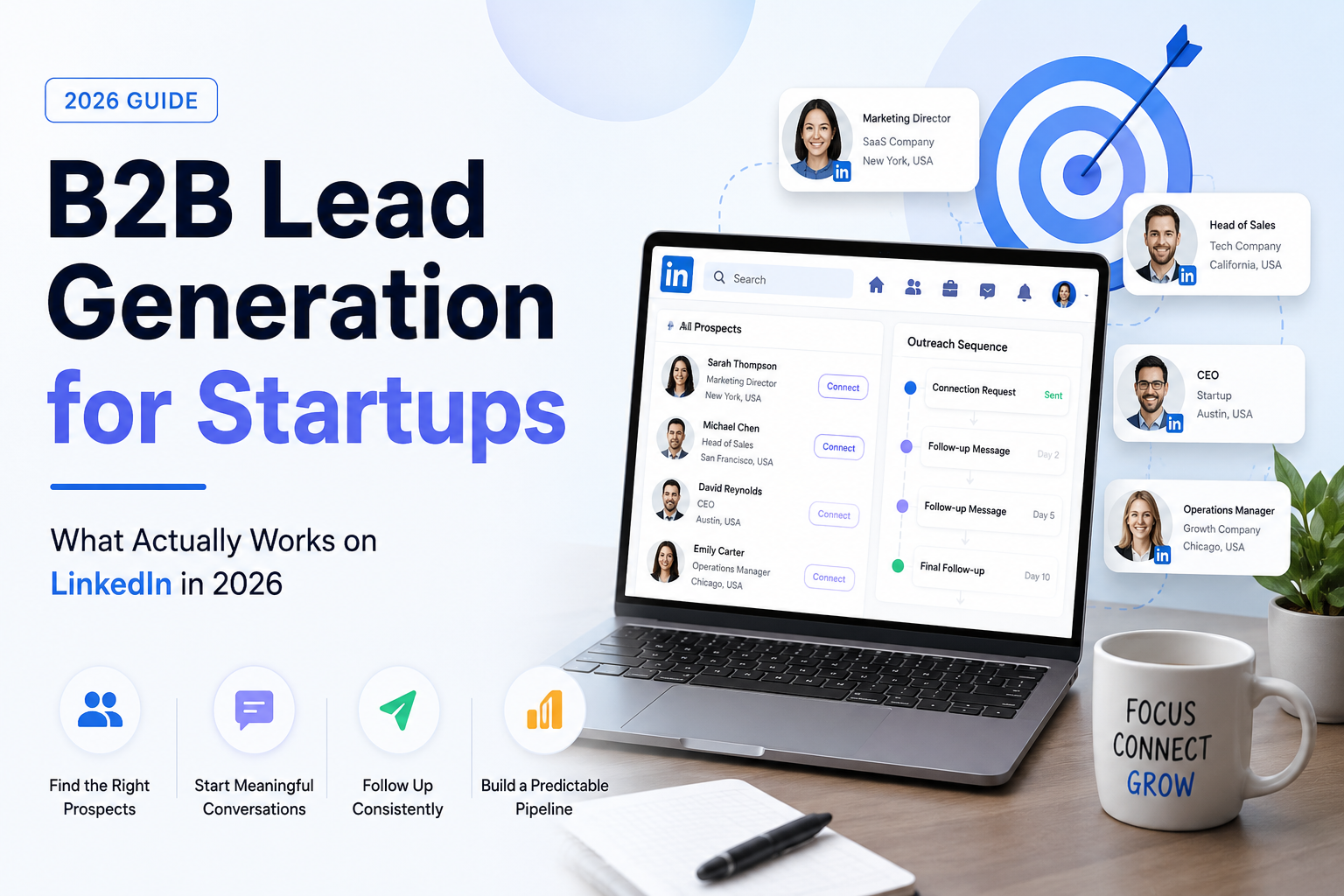
Most startup founders don't have a lead generation problem.
They have a consistency problem.
A founder spends hours building a prospect list, sends a few connection requests, gets a handful of replies, then gets pulled back into product development, customer support, fundraising, or hiring. Outreach slows down. Follow-ups get missed. Conversations go cold.
A few weeks later, the pipeline is empty again.
The cycle repeats.
We've seen this pattern repeatedly across startup outreach campaigns. The issue is rarely a lack of prospects. More often, it's the absence of a repeatable system for finding, contacting, and following up with the right people.
That's why LinkedIn has become one of the most effective channels for startup lead generation—and why a LinkedIn outreach tool is increasingly becoming an essential part of a startup's growth stack.
In this guide, we'll break down what actually works, where founders typically struggle, and how startups can build a predictable lead generation engine using LinkedIn.
Why Startup Lead Generation Is Different
Established companies often have advantages that startups don't:
Brand recognition
Existing customer bases
Dedicated sales teams
Large marketing budgets
Startups typically have none of those advantages.
Most founders are simultaneously:
Building the product
Supporting customers
Hiring employees
Managing operations
Raising capital
Driving sales
As a result, lead generation often becomes inconsistent.
The problem is that prospects don't buy according to your schedule.
They buy when the timing is right for them.
That means startups need a process that keeps conversations moving even when founders are focused on other priorities.
Why LinkedIn Has Become the Default B2B Prospecting Channel
LinkedIn offers something most marketing channels cannot:
Direct access to decision-makers.
Instead of waiting for prospects to discover your company through search engines or advertising, you can proactively connect with:
Founders
CEOs
Marketing leaders
Sales directors
Operations managers
HR leaders
Technology executives
For many startups, LinkedIn becomes the shortest path from "nobody knows who we are" to "we have paying customers."
But success on LinkedIn isn't about sending more messages.
It's about starting more relevant conversations.
The START Framework for Startup Lead Generation
Over time, we've noticed that successful startup outreach campaigns tend to follow the same pattern.
We call it the START Framework.
S — Select a Precise ICP
The most successful campaigns begin with a clearly defined Ideal Customer Profile (ICP).
Poor targeting:
SaaS companies
Better targeting:
US-based SaaS companies with 10–50 employees where the founder is still actively involved in sales.
The more specific your ICP, the easier prospecting, messaging, and follow-up become.
T — Target the Right Prospects
Many founders think they need thousands of leads.
Most don't.
A list of 100 highly qualified prospects is often worth more than a list of 5,000 loosely relevant contacts.
Focus on:
Job title
Industry
Company size
Geography
Buying signals
Buying signals are indicators that a company may already be looking for a solution. Examples include:
Recent fundraising announcements
Rapid hiring activity
Leadership changes
New market expansion
Public discussions about challenges your product solves
These signals often indicate a higher likelihood of engagement because the company is already experiencing change or growth.
Quality almost always beats volume.
A — Approach Personally
This is where many outreach campaigns fail.
Generic messages are easy to ignore.
Compare these two approaches:
Generic Outreach
Hi John,
I help companies improve their sales process.
Would love to connect.
Personalized Outreach
Hi John,
Saw you're leading growth at a Series A SaaS company.
I've been speaking with several startup teams that struggle to maintain consistent outbound follow-ups while founders are still handling sales themselves.
Curious if that's something you've experienced as well.
The second message doesn't immediately pitch.
It starts a conversation.
That's the objective.
For more examples, see our guide to LinkedIn Message Templates for Every Stage of the Sales Funnel.
R — Repeat Follow-Ups
One of the most expensive mistakes founders make is stopping after one message.
A prospect may:
Be busy
Miss the notification
Intend to reply later
Be interested but have poor timing
The goal of outreach isn't immediate replies.
The goal is staying visible until timing aligns.
Here's a pattern we see repeatedly:
Startup founders rarely lose deals because they contacted too few prospects. They lose deals because they stop following up too early.
Consistent follow-up often separates successful campaigns from failed ones.
T — Track and Improve
Lead generation is a process.
Track:
Connection acceptance rates
Reply rates
Positive response rates
Meetings booked
Opportunities created
Small improvements at each stage compound into significant growth over time.
The Startup Outreach Reality Check
If your campaign has:
No ICP definition
No follow-up sequence
No response tracking
No weekly prospecting process
you don't have a lead generation system.
You have a lead generation experiment.
The startups that consistently generate pipeline usually aren't doing anything revolutionary.
They're simply executing the fundamentals consistently.
In fact, many founders struggle not because of poor products or weak messaging, but because their outreach process breaks down over time. We explored the most common causes in our guide on Why 90% of Outreach Campaigns Fail (and How Smart Teams Fix Them).
What We Consistently See Across Startup Outreach Campaigns
Every startup is different, but several patterns appear repeatedly.
Pattern 1: Narrow Campaigns Usually Outperform Broad Campaigns
Campaigns targeting a single ICP often generate more meaningful conversations than campaigns targeting everyone.
Specificity creates relevance.
Relevance creates replies.
Pattern 2: Personalization Matters More Than Volume
Sending 500 generic messages rarely outperforms sending 50 highly relevant messages.
Many startups focus on scaling outreach before they've learned how to make outreach resonate.
That's backwards.
Pattern 3: Consistency Beats Intensity
Many founders run outreach in bursts.
Three days of activity followed by three weeks of silence.
The strongest pipelines are usually built through consistent weekly prospecting rather than occasional high-volume outreach.
This inconsistency is one of the most common reasons campaigns underperform. If you're seeing low reply rates despite targeting the right prospects, our article on Why 90% of Outreach Campaigns Fail (and How Smart Teams Fix Them) breaks down the operational mistakes that quietly kill outreach performance.
When Do You Need a LinkedIn Outreach Tool?
Manual outreach works initially.
Eventually, it becomes difficult to manage.
| Manual Process | LinkedIn Outreach Tool |
|---|---|
| Spreadsheet tracking | Centralized campaign management |
| Manual reminders | Structured follow-up sequences |
| Repetitive tasks | Streamlined workflows |
| Difficult reporting | Campaign analytics |
| Inconsistent execution | Repeatable process |
The purpose of a LinkedIn outreach tool isn't to replace relationships.
It's to remove operational friction so founders can spend more time having meaningful conversations.
How Alipro Supports Startup Outreach
Unlike many LinkedIn outreach tools that focus primarily on automation, Alipro helps startups build structured lead generation systems that combine prospect discovery, campaign management, follow-up workflows, and performance tracking in a single platform.
Instead of managing disconnected spreadsheets, reminders, prospect lists, and follow-up notes, teams can organize the entire outreach workflow in one place.
With Alipro, startups can:
Discover targeted prospects
Build multi-step outreach campaigns
Track lead progression through outreach stages
Manage follow-up sequences
Monitor campaign performance
Maintain visibility across multiple campaigns
The key difference is structure.
For example, instead of manually remembering who received a connection request, who replied, who needs a follow-up, and who booked a meeting, startups can manage the entire process through a single workflow.
For lean teams, structure is often more valuable than scale.
The goal isn't to send more messages.
The goal is to create more meaningful conversations with qualified prospects.
Common LinkedIn Outreach Mistakes
Pitching Too Early
Most prospects don't respond well to immediate sales pitches.
Start conversations first.
Sell later.
Targeting Everyone
A broad audience usually creates weak messaging.
Narrow targeting creates stronger messaging.
Following Up Only Once
Many opportunities are lost simply because nobody followed up.
Follow-up failures are only one piece of the puzzle. We covered additional outreach breakdowns—including poor targeting, inconsistent execution, and weak campaign structure—in Why 90% of Outreach Campaigns Fail (and How Smart Teams Fix Them).
Measuring Activity Instead of Results
Connection requests sent is not a success metric.
Meetings booked is.
Pipeline created is.
Revenue generated is.
Frequently Asked Questions
What is a LinkedIn outreach tool?
A LinkedIn outreach tool helps businesses manage prospecting, follow-ups, campaign organization, and outreach workflows more efficiently.
Is LinkedIn still effective for B2B lead generation?
Yes. LinkedIn remains one of the most effective channels for reaching decision-makers, especially for startups selling B2B products and services.
How many connection requests should startups send daily?
The ideal number depends on account history, activity level, and outreach quality. Most startups benefit more from sending highly targeted requests consistently than from maximizing volume.
What's more important: personalization or scale?
Personalization.
Scale simply amplifies whatever process already exists. If your message isn't relevant, sending more of it usually doesn't improve results.
How is Alipro different from other LinkedIn outreach tools?
Most LinkedIn outreach tools focus primarily on automating actions. Alipro focuses on helping startups build repeatable lead generation systems by combining prospect discovery, campaign organization, follow-up management, and performance tracking in a single workflow. The goal is not simply to send more messages but to help founders create a predictable outreach process.
When should a startup start using a LinkedIn outreach tool?
Usually when managing outreach manually begins consuming too much time, follow-ups become difficult to track, or multiple campaigns need to run simultaneously.
Final Thoughts
A founder doesn't need thousands of leads.
A founder needs consistent conversations with the right people.
That's what turns outreach into revenue.
The startups that succeed on LinkedIn are rarely the ones sending the most messages. They're the ones following a repeatable process, targeting the right prospects, and staying consistent long enough for opportunities to develop.
Whether you're generating your first leads or building a scalable outbound engine, the combination of a clear strategy and the right LinkedIn outreach tool can transform prospecting from a sporadic activity into a predictable growth channel.
If you're serious about B2B lead generation, focus on improving the process before increasing the volume.
The results usually follow.
Startups that consistently generate pipeline don't rely on random outreach. They rely on repeatable systems. That's the philosophy behind Alipro's LinkedIn outreach platform, which helps founders organize prospecting, follow-ups, and campaign management in one place.
Content Team
The ALipro team writes about LinkedIn outreach, B2B sales automation, and lead generation strategies for modern sales teams.