Why Most Outreach Campaigns Fail (And the Simple Fix Top Founders Discovered)
Most outreach campaigns don't fail from bad copy — they fail because follow-ups get forgotten and manual processes don't scale. Here's why, and how a system fixes it.
The Message That Never Got a Reply
Three months. 317 connection requests. 89 personalized messages. 17 follow-ups.
Zero customers.
When Jake, a SaaS founder, looked at his LinkedIn inbox that Friday evening, he couldn't understand what went wrong. His product was good. His pricing was competitive. His targeting was right.
Yet a competitor with a smaller team and less funding was closing deals faster than he was.
Jake eventually found out why: his competitor wasn't sending better messages. They were running a system — every prospect moved through the same structured sequence, every follow-up happened on schedule, and nothing depended on someone remembering to do it. Jake was relying on willpower. They were relying on process.
That distinction is the whole story.
The Outreach Problem Nobody Talks About
Most people think outreach is about sending messages. It isn't.
Outreach is a chain of small, unglamorous tasks that all have to happen before a prospect ever replies: finding qualified prospects, verifying relevance, visiting profiles, sending requests, tracking acceptances, sending follow-ups, monitoring replies, avoiding duplicates, and staying within platform limits.
Most campaigns don't fail because of bad copy. They fail because of broken execution — a step gets skipped, a follow-up gets forgotten, and the prospect simply moves on.
The Silent Killer: Forgotten Follow-Ups
Picture 500 well-qualified prospects, organized neatly on day one. Then reality intervenes — a support fire, a bug, an investor call, a launch. Outreach pauses for a week, then two, then it quietly stops.
The prospects aren't lost because they weren't interested. They're lost because nobody followed up.
Buyers rarely respond on the first message. Closing a deal typically takes several touchpoints over time — yet most founders stop after one or two attempts simply because manual follow-up is tedious to sustain. Every skipped touchpoint is a deal that was never lost on merit, only on neglect.
The Myth of "Personalized" Outreach
Most people say they personalize outreach. Few actually do, because real personalization at scale takes more time than most founders have.
What usually ships instead is a name swapped into an otherwise identical template — and prospects can tell. Inboxes are full of these messages, so a generic one becomes invisible before it's even read.
The irony: founders know this. They just don't have a way to personalize and scale at the same time without a system doing the heavy lifting.
What Breaks When You Try to Scale
Outreach that works at 20 prospects a week often breaks at 200. New questions appear constantly: Who's already been contacted? Who accepted? Who needs a follow-up? Which campaign or audience is actually converting?
Most teams try to answer this with a spreadsheet. It works for a while — then rows multiply, campaigns overlap, data goes stale, and nobody fully trusts the numbers anymore. Decisions become guesses dressed up as data.
The Cost Nobody Puts on a Slide
Founders track software spend closely. They rarely track time spend.
A modest manual outreach routine — sourcing, sending, follow-ups, spreadsheet upkeep — can easily eat 3–4 hours a day. Over a year, that's close to 1,000 hours spent on repetitive clicks rather than closing deals, building product, or serving customers.
The question worth sitting with: is manually managing LinkedIn outreach really the highest-value use of a founder's time?
What Outreach Teams That Win Actually Do
The best-performing teams aren't working harder — they've built a repeatable system. Every prospect moves through the same process whether the founder is in back-to-back meetings, on a plane, or asleep. Nothing depends on memory. Nothing depends on having a free afternoon.
That consistency is what turns outreach from a hustle into a predictable input — and predictable inputs produce predictable revenue.
How Alipro Fits In
Alipro was built around one question: what if outreach could run like an organized sales team, even for a solo founder?
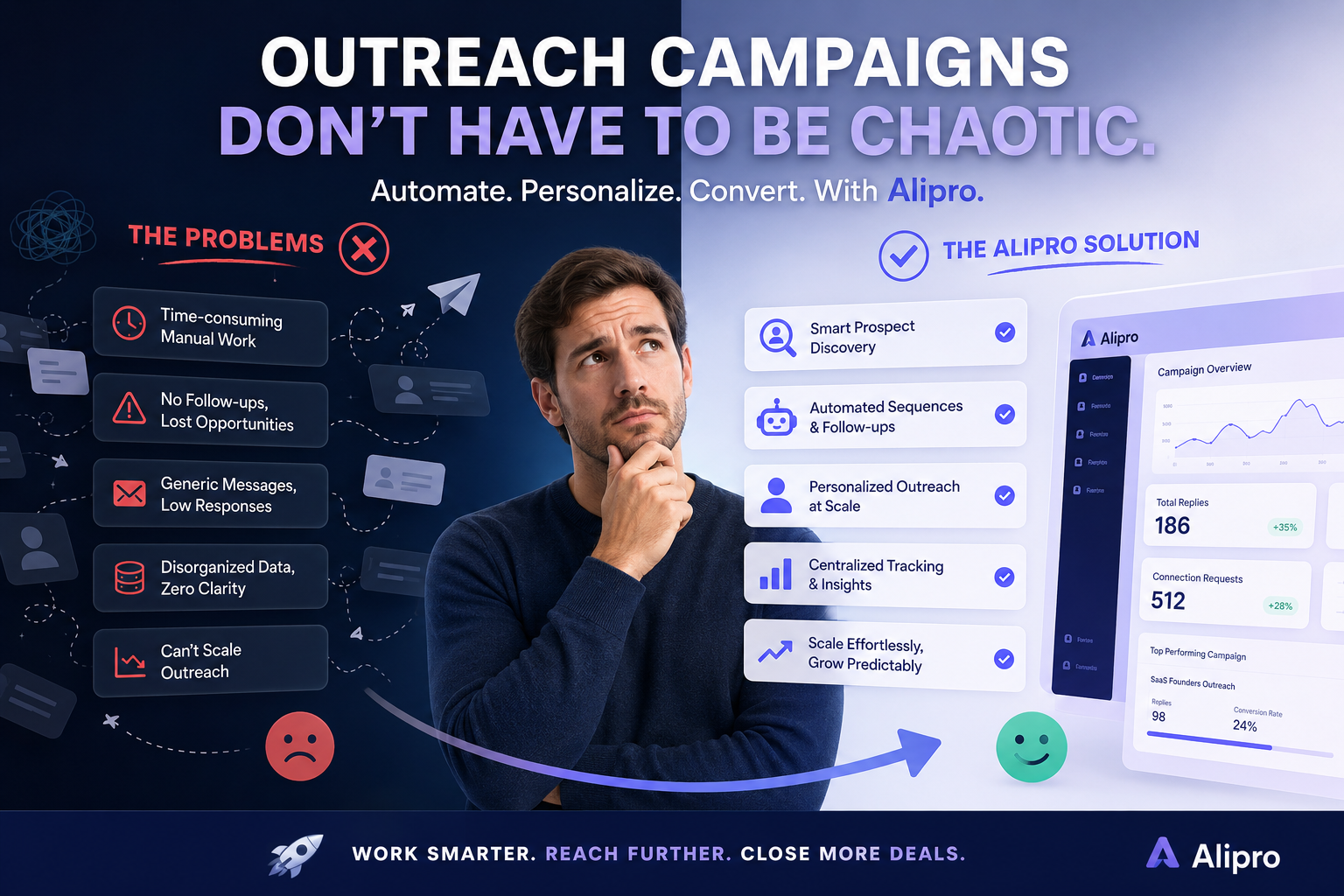
- Find qualified prospects — filtered by audience, industry, role, and market, instead of hours of manual scrolling.
- Build structured sequences — profile visits, connection requests, messages, and follow-ups, organized as one tracked workflow instead of scattered manual steps.
- Automate follow-ups — so conversations continue on schedule even when you're heads-down on something else.
- Track every prospect — see at a glance who connected, replied, went quiet, or needs another touch, without a spreadsheet.
- Scale without losing visibility — the same level of control whether you're running 50 outreach touches a week or 5,000.
One important note: LinkedIn has clear limits on automated activity, and exceeding them can put an account at risk regardless of which tool you use. Alipro is built to work within platform-safe sending limits — the goal is sustainable, compounding outreach, not short-term volume that gets an account flagged.
The Real Win Isn't Automation — It's Consistency
Time saved is the obvious benefit. The bigger one is consistency: showing up for every prospect, every time, without gaps. Consistency is what turns outreach into conversations, conversations into pipeline, and pipeline into revenue.
Six months from now, the founder running a system will have contacted more prospects, followed up more reliably, and built a larger pipeline than the one doing it all manually — not because they worked harder, but because their outreach didn't depend on having the time and energy to do it themselves every single day.
If that's the gap you're trying to close, start a free trial with Alipro and see what your pipeline looks like when follow-up isn't optional.